What Commercial Real Estate Means
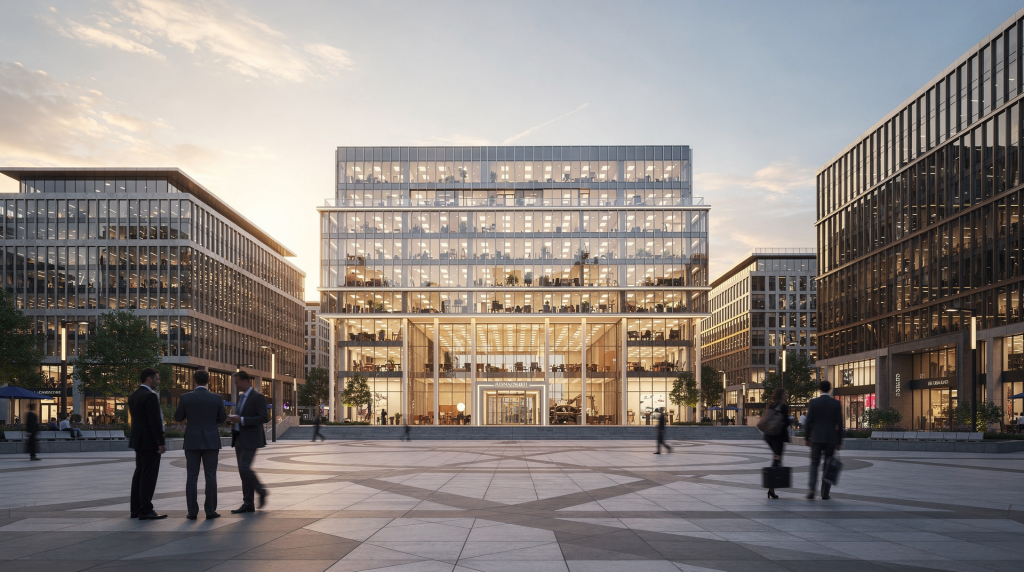
Commercial real estate — often shortened to CRE — is property used primarily for business activity rather than residential living. It covers any space leased or owned for operations: offices, retail units, manufacturing floors, logistics hubs, service delivery points, and hospitality venues. The common thread is that the space exists to generate revenue or support revenue-generating activity.
In practice, the definition is broader than most people assume. A single storefront on a high street, a multi-tenant office building in a business park, a last-mile distribution warehouse, or a mixed-use development combining retail and workspace — all fall under commercial real estate if the primary use is business. The classification matters because it determines everything from lease structure and tax treatment to operational obligations and flexibility.
For a business operator, understanding this category isn’t about legal definitions. It’s about recognizing that the space you occupy is an operational asset — one that either enables how your teams work or quietly works against them.
Why Commercial Real Estate Matters to Businesses
Think of commercial real estate as the physical operating system your business runs on. When the space is too expensive, too rigid, too small, or poorly laid out, the business absorbs the cost in ways that don’t show up on a rent statement: slower workflows, weaker collaboration, higher churn, missed revenue opportunities. The space isn’t a backdrop — it’s infrastructure.
This is where the operational lens becomes critical. A warehouse with inefficient bay spacing adds minutes to every load. An office with no quiet zones forces focused work into noisy corners. A retail unit with poor footfall visibility bleeds potential customers daily. These aren’t real estate problems — they’re business performance problems that happen to live inside a property.
1. It affects your operating costs
Commercial property costs extend well beyond the headline rent. In the UK, businesses typically carry business rates, service charges, utilities, insurance, maintenance, waste removal, and fit-out costs — often as separate line items with different escalation patterns. Two spaces with identical monthly rent can diverge by 20–30% in total occupancy cost once repairs, service charge caps, and tenant obligations are factored in.
I’ve seen companies anchor on a low rent figure only to discover that uncapped service charges or full repairing obligations push their real cost per square metre well above alternatives. The discipline here is simple: model the total cost of occupancy over the lease term, not the monthly rent in isolation. That includes understanding which costs are fixed, which are variable, and who bears the risk when things break.
2. It influences productivity and employee experience
Office layout and workspace quality don’t just affect comfort — they shape how work actually gets done. A well-designed space supports different work modes: focused individual tasks, small-group collaboration, confidential conversations, and larger team gatherings. When the environment matches the rhythm of work, people spend less time compensating for the space and more time on the task.
Practically, this means:
- Better concentration through acoustic zoning and visual privacy
- Easier teamwork when collaboration areas are adjacent to desks, not three floors away
- More efficient meetings because rooms are sized and equipped for actual use patterns
- Improved employee comfort through lighting, air quality, and thermal control
- Stronger retention in roles where the physical environment signals investment in people
A cramped or outdated office does the reverse. It introduces friction — people walking long distances for a quick conversation, booking rooms that don’t exist, or tolerating noise levels that fracture attention. Over a year, that friction compounds into measurable productivity loss and, often, higher voluntary turnover.
3. It impacts growth and flexibility
Business needs shift. A company might hire rapidly, move to hybrid attendance patterns, open a regional hub, or consolidate teams after an acquisition. If the property structure is rigid — long lease, fixed layout, limited expansion options — those changes become expensive, slow, or both.
A flexible commercial space gives the business room to maneuver:
- Scale up or down without triggering a relocation
- Reconfigure layouts as team sizes and functions evolve
- Add or remove collaboration zones based on actual utilization data
- Reduce wasted square footage that generates cost but no value
Flexibility isn’t a design preference; it’s a hedge against uncertainty. The companies that handle growth most efficiently are often the ones whose spaces can absorb change without requiring a lease renegotiation or a full fit-out.
4. It shapes brand and customer perception
For customer-facing businesses, the physical environment is part of the brand experience. A retail unit, a clinic, a hospitality venue, or an office used for client meetings all communicate quality before anyone speaks. The condition of the space, the logic of the layout, the ease of access — these are silent signals that build or erode trust.
A clean, well-located, functionally coherent space reinforces competence. A confusing layout, poor accessibility, or visible neglect does the opposite, often before the customer can articulate why they feel uneasy. In service businesses, the space is a delivery channel — and it deserves the same attention as any other customer touchpoint.
Commercial Real Estate vs Residential Property
Commercial and residential property operate under fundamentally different rules. The core distinction is purpose: residential property provides living space, while commercial property exists for business activity or income generation. That single difference cascades into how leases are structured, how costs are allocated, and how much operational impact the space carries.
| Aspect | Commercial Real Estate | Residential Property |
|---|---|---|
| Purpose | Business use or income generation | Living space |
| Typical tenants | Businesses, organisations, operators | Individuals, families |
| Costs | Rent, business rates, service charges, fit-out, utilities | Rent or mortgage, household bills |
| Lease complexity | Usually more negotiated and detailed | Often simpler |
| Business impact | Directly affects operations and productivity | Usually indirect for the tenant |
This distinction matters because a commercial lease is rarely just about occupancy. It’s a document that allocates risk, defines control, and sets the boundaries for how the business can use and modify the space over time. Treating it like a residential tenancy agreement is one of the most expensive mistakes a business can make.
What Businesses Should Evaluate Before Choosing a Space
A sound commercial property decision starts with operational requirements, not square footage. The most common failure pattern I see is companies starting with a budget and a floor area target, then trying to fit their operations into whatever space meets those numbers. The sequence should be reversed: define how the business needs to work, then find space that enables that.
1. Function first
Start by mapping what the space actually needs to support:
- Focused individual work — how many people, how often, what level of acoustic privacy
- Team collaboration — spontaneous and scheduled, small groups and large
- Client meetings — frequency, confidentiality requirements, impression goals
- Storage — volume, access frequency, security needs
- Shipping or logistics — loading requirements, throughput, staging areas
- Hybrid attendance — peak occupancy days, hot-desking ratios, locker needs
- Specialist equipment — power, ventilation, floor loading, clearance
If the space doesn’t support the real work patterns, it becomes a constraint rather than an enabler — and the business pays for that constraint every day.
2. Total cost, not just rent
Before signing, build a complete occupancy cost model that includes:
- Business rates
- Service charges (with caps and exclusions understood)
- Utilities and energy performance implications
- Repairs and maintenance obligations under the lease
- Insurance
- Internet and telecoms infrastructure
- Fit-out, refurbishment, or decoration
- Furniture, fixtures, and equipment
A unit that looks cheap on a per-square-metre basis can become expensive once all-in costs are calculated — especially if the lease pushes repair liability onto the tenant or service charges are uncapped.
3. Lease responsibilities
In the UK, a commercial lease typically specifies who handles repairs, maintenance, and renewal terms with far more granularity than a residential agreement. Review these elements carefully:
- Who bears responsibility for internal and external repairs
- Whether service charges are fixed or variable, and what they cover
- What happens at lease renewal — rights, notice periods, rent review mechanisms
- Whether the business can exit early via a break clause, and on what conditions
- What alterations are permitted without landlord consent
These clauses aren’t boilerplate — they define the operational flexibility and financial exposure for the entire occupancy period.
4. Compliance and access
A property must support health and safety, fire safety, and accessibility requirements from day one. If the building doesn’t meet these basics, the business faces not just compliance risk but potential operational disruption — temporary closures, retrofit costs, or liability exposure that could have been avoided during selection.
5. Layout and adaptability
Modern businesses increasingly need spaces that can evolve without requiring a move. Flexible workspace design — demountable partitions, modular furniture systems, zoned services — allows the space to support different work modes as the organization changes. This isn’t about aesthetics; it’s about reducing the cost and friction of adaptation over time.
Step-by-Step: How to Assess a Commercial Space
- Define the business purpose of the space — what outcomes it needs to enable
- Estimate how many people will use it and on what attendance patterns
- Map the work types it must support, including peak concurrent demands
- Calculate total occupancy cost over the lease term, not just monthly rent
- Review lease terms and repair obligations with operational impact in mind
- Check compliance, access, and building condition — not just visually, but through documentation
- Test whether the layout can adapt over time without major capital expenditure
- Compare the space against future growth plans — does it accommodate 2–3 years of likely change
Common Mistakes Businesses Make
Mistake 1: Choosing space based on price alone
Low rent often masks high service charges, deferred maintenance, or a layout that forces operational compromises. The cheapest space on a rent-per-square-metre basis is rarely the cheapest on a total-cost-of-occupancy basis — and almost never the best for productivity.
Mistake 2: Ignoring operational workflow
An office that looks good on a floor plan can still fail if teams need constant movement between departments, frequent ad-hoc meetings, or secure storage that isn’t adjacent to workstations. The test isn’t whether the space looks right — it’s whether the work flows through it without friction.
Mistake 3: Overestimating or underestimating space needs
Too much space wastes capital that could fund growth. Too little creates bottlenecks that limit performance. The right answer depends on actual work patterns and utilization data, not benchmarks or vanity metrics. A company with high remote attendance needs less desk space but may need more collaboration areas — the ratio shifts.
Mistake 4: Treating the lease as a formality
Commercial leases are operational documents. They define who pays for what, how long the commitment lasts, and what flexibility exists to change course. Signing without understanding repair obligations, service charge structures, or break clause conditions is effectively making a multi-year operational decision blind.
Mistake 5: Forgetting the employee experience
Workplace quality affects how people feel and perform. Natural light, thermal comfort, acoustic control, and practical layouts influence daily productivity more than most organizations measure. A space that signals indifference to employee wellbeing tends to see that indifference reflected in engagement and retention metrics.
Commercial Real Estate in a Hybrid Work World
Hybrid work has fundamentally changed what companies need from office space. The shift isn’t about reducing square footage — it’s about reallocating it toward higher-value activities. UK businesses are increasingly treating the office as a destination for collaboration, client interaction, team culture, and focused work that benefits from dedicated environment, rather than a container for rows of assigned desks.
This means the office is now judged by what it enables, not just what it costs. The metrics that matter are utilization rates by zone, collaboration frequency, employee sentiment, and the degree to which the space supports hybrid workflows — not just headcount capacity. The office becomes a tool for improving performance and retention, not a fixed overhead to be minimized.
Practical Checklist for Business Leaders
Use this before committing to a space:
- Does the location support employees, clients, and operational logistics?
- Is the layout suitable for the actual work being done, not just the org chart?
- Are all occupancy costs clear, including variable charges and repair exposure?
- Are repair and maintenance responsibilities acceptable and budgeted?
- Does the building comply with safety, fire, and accessibility requirements?
- Can the space adapt as the company grows, shrinks, or changes work patterns?
- Does the workplace experience support productivity and signal quality to staff?
- Will this property still make operational and financial sense in 2–3 years?
When to Bring in Expert Help
Commercial real estate decisions sit at the intersection of operations, finance, HR, facilities management, and legal. Few organizations have all that expertise in-house — and even fewer have the capacity to integrate it into a coherent space strategy. That’s why businesses often benefit from external guidance when evaluating leases, layouts, and long-term footprint planning.
A good real estate decision doesn’t just secure a building. It aligns the physical environment with how the business actually works — and keeps it aligned as the business changes. The goal isn’t a signed lease; it’s an operational platform that supports performance over time.
FAQ
What is commercial real estate in simple terms?
Commercial real estate is property used for business purposes — offices, retail spaces, warehouses, industrial buildings, and similar assets where the primary activity is commercial rather than residential.
Why is commercial real estate important for businesses?
It directly affects operating costs, productivity, employee experience, customer perception, and the company’s ability to grow or adapt. The space a business occupies is operational infrastructure, not just a cost centre.
What costs come with commercial property in the UK?
Beyond rent, businesses typically pay business rates, service charges, utilities, maintenance, insurance, and fit-out costs. Some leases also transfer repair obligations to the tenant, which can significantly increase total occupancy cost.
What should a business check before signing a commercial lease?
Review repair responsibilities, renewal terms, break clause conditions, compliance requirements, total occupancy cost, and whether the space supports actual operational needs — not just headcount capacity.
Is office design really that important?
Yes. Workspace design influences collaboration patterns, concentration, comfort, and overall productivity. In a hybrid model, the office must earn the commute — and design is a major factor in whether it does.
Conclusion
Commercial real estate matters because it connects space decisions to business performance. The right property supports operations, controls costs, and gives the company room to grow. The wrong one creates friction, waste, and hidden expense that compounds over the lease term.
For business leaders, the real question isn’t “What space can we afford?” It’s “What space will help us work better?” Answering that requires looking at real estate through an operational lens — and making decisions based on how the business actually runs, not just how the property looks on a tour.