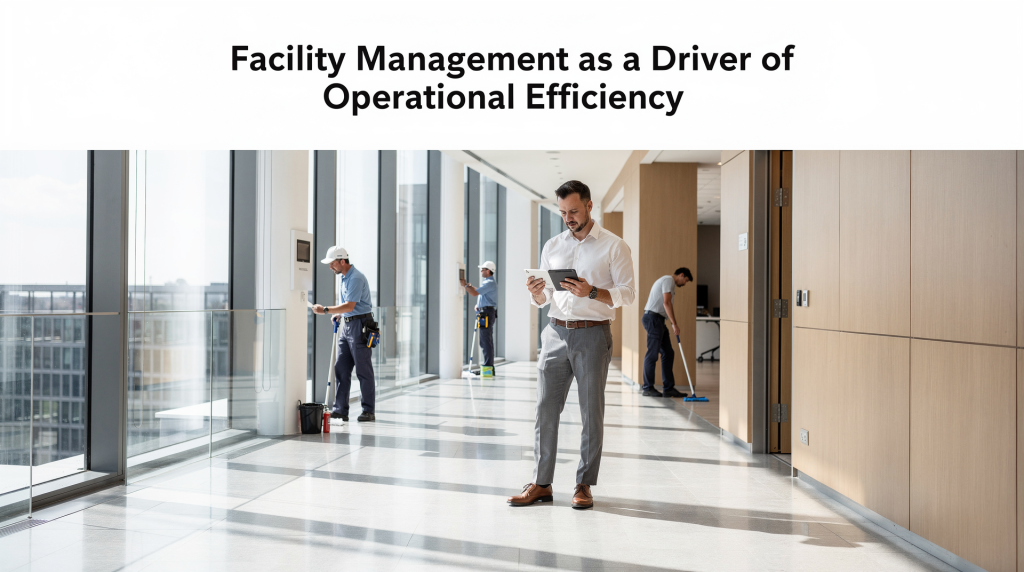
For too many businesses, facility management still lives in a reactive loop: fix what breaks, pay the utility bills, and keep the cleaners on schedule. But when you pull back and look at how work actually flows through a building, it becomes clear that the facilities function is either a quiet enabler of operational efficiency or a persistent drag on it. Every hour of downtime, every square foot of underused space, every uncomfortable workstation chips away at output and cost control. Managed strategically, the building shifts from passive overhead to an active part of the operating model—one that directly supports how the business performs, scales, and manages cost.
Why facility management affects operational efficiency
Operational efficiency is about getting better results from the same or fewer resources. In the context of commercial space, that means reducing waste in time, space, money, and effort. Facility management influences all four, often in ways that don’t show up on a standard P&L until you start connecting building performance to business processes.
A poor facilities function creates friction everywhere: teams lose time waiting for repairs, staff work in uncomfortable or poorly designed spaces, energy is wasted on empty rooms, assets fail unexpectedly, and managers make real estate decisions without reliable building data. When a lease is signed, the clock starts ticking on cost per square foot, and every inefficiency in how that space is used becomes a recurring operational expense. A strong facilities function does the opposite. It keeps critical systems running, supports employee productivity, and gives leadership the data to make smarter decisions about the real estate footprint—whether that means reconfiguring a floor plate, renegotiating a lease, or right-sizing the portfolio.
What facility management actually covers
Facility management is broader than many leadership teams realize. It sits at the intersection of people, property, processes, and technology—and when it’s working well, it translates operational requirements into physical space that supports them. That means the scope goes well beyond fixing a broken light or scheduling a cleaner.
Core areas of facility management
- Building maintenance and repairs
- Planned preventative maintenance
- Cleaning and soft services
- Health and safety compliance
- Security and access control
- Energy and utilities management
- Space planning and workplace support
- Vendor and contract management
- Workplace technology and smart building systems
The key point is simple: facilities management is not a side function. It affects how reliably the business can operate every day, and it has a direct line to the cost and flexibility of the real estate portfolio.
How facility management improves operational efficiency
1. It reduces unplanned downtime
Unexpected equipment failures are one of the fastest ways to lose productivity—and in a leased commercial space, they also erode the value of the square footage you’re paying for. A broken HVAC system, a failed access control point, or an interrupted power supply can stop work immediately or force teams into workaround mode, effectively increasing the cost per productive hour.
The practical fix is a shift from reactive to planned maintenance. I’ve seen buildings where a reactive maintenance ratio above 30% was a clear signal that the business was paying a premium for urgency that could have been avoided with better planning.
What effective maintenance looks like
- Routine inspections for critical assets
- Service schedules based on usage, not just calendar dates
- Clear ownership for each building system
- Tracking of repeat faults and root causes
- Response times measured in hours, not vague promises
A useful rule: if the same issue keeps returning, the process behind it is usually broken, not just the equipment. And when that process breaks, it’s not just a maintenance problem—it’s a drag on the entire operation.
2. It improves how space is used
Space is one of the most expensive resources a business controls, especially in commercial offices where lease commitments can run for years. Yet many workplaces still run with outdated assumptions about occupancy, meeting room demand, desk usage, and support areas. I’ve seen companies carry 20% more space than they need simply because no one connected the facilities data to the lease renewal decision.
Facility management can uncover where space is wasted and where bottlenecks appear. When you start measuring actual utilization against the footprint you’re paying for, the conversation shifts from “we need more space” to “we need to use what we have more intelligently.”
Common space inefficiencies
- Underused meeting rooms
- Oversized storage areas
- Workstations that stay empty most of the week
- Poor adjacencies between teams that collaborate often
- Circulation space that serves no useful function
When space data is visible, leaders can reconfigure layouts, reduce the footprint, or repurpose areas for higher-value work—all of which feed directly into lower occupancy costs and a more agile workplace.
3. It lowers operating costs
Operational efficiency is not only about speed. It is also about reducing unnecessary cost, and facility management has a direct effect on utilities, maintenance spend, supplier costs, and the hidden cost of disruption. In a typical office building, energy, cleaning, and maintenance can account for a significant slice of the total occupancy cost, and small inefficiencies compound over the term of a lease.
Typical cost levers
- Energy use per square foot or square metre
- Maintenance spend split between planned and reactive work
- Cleaning frequency aligned to actual occupancy
- Vendor consolidation across services
- Better purchasing and contract management
Many businesses save money not by cutting facilities budgets blindly, but by removing waste inside the facilities model. For example, aligning cleaning schedules to actual badge-swipe data often reveals that you’re paying for daily cleaning in areas used twice a week—a direct operational saving that requires no capital outlay.
4. It supports employee productivity
Employees do not work well in spaces that are too hot, too cold, noisy, dirty, poorly lit, or constantly breaking down. These issues may seem small individually, but they add up fast—and they have a measurable impact on output. When people spend even 30 minutes a day dealing with environmental distractions, that’s 2.5 hours a week of lost focus per person.
Facility management affects the conditions people work in every day. That includes thermal comfort, lighting quality, acoustics, cleanliness, availability of working equipment, and ease of moving through the building. If people are constantly distracted by environmental issues, their output drops. Good facilities management removes that drag, and in doing so, it protects the return on the organization’s largest operational investment after people: the space itself.
5. It strengthens compliance and reduces risk
Compliance failures create operational inefficiency because they consume time, create liability, and distract leadership. In the UK context, businesses must pay close attention to health and safety duties, fire safety requirements, accessibility considerations, statutory inspections, and record keeping for critical assets. A missed inspection or an outdated fire risk assessment doesn’t just expose the business legally—it can shut down operations entirely.
A well-managed facilities function keeps documentation current, tasks scheduled, and risks visible before they become incidents. This proactive stance is itself an efficiency play: it prevents the kind of fire-drill remediation that pulls resources away from core work and often costs far more than routine compliance would have.
The KPIs that matter most
If facility management is supposed to drive efficiency, it has to be measured properly. The most useful metrics are the ones that connect building performance to business impact—not just activity counts, but outcomes that show up in the P&L.
| KPI | What it tells you | Why it matters |
|---|---|---|
| Planned vs reactive maintenance ratio | Whether work is being managed proactively | A high reactive share usually means more downtime and higher costs; it’s a leading indicator of operational risk. |
| Mean time to repair | How quickly issues are resolved | Direct indicator of service speed and disruption; longer times erode user confidence and productivity. |
| First-time fix rate | Whether repairs are completed properly on the first visit | Lower repeat visits mean less wasted time and labor, and fewer interruptions to the business. |
| Energy use intensity | How much energy the building consumes relative to size | Reveals waste and savings opportunities; often the easiest cost to attack with better controls. |
| Space utilization rate | How much space is actually being used | Helps right-size the workplace and informs lease renewal or redesign decisions. |
| Occupant satisfaction | How employees experience the environment | Links facilities performance to productivity and retention; a dissatisfied workforce is an expensive one. |
| Cost per square foot/metre | The real cost of running the estate | Useful for benchmarking and budget control; ties facilities spend directly to the real estate footprint. |
How to build a more efficient facilities model
Step 1: Map what is happening now
Start with a clear picture of the current state. Do not begin with software or a service contract. Begin with the facts. Walk the floors, pull the maintenance logs, and talk to the people who use the space every day. You’re looking for the friction points that slow work down or drive unnecessary cost.
Ask: Which assets fail most often? Where are the repeat service requests? Which spaces are underused? What tasks are handled reactively instead of on schedule? Which vendors create the most friction? Where are the highest utility spikes? This baseline shows where inefficiency is coming from—and it often reveals that the biggest problems aren’t where leadership assumed they were.
Step 2: Prioritize the assets and spaces that matter most
Not every system deserves the same level of attention. A coffee machine failure is inconvenient. A cooling failure in a server room or a main HVAC breakdown is operationally serious and can halt revenue-generating activity. Rank assets and spaces by business criticality, safety impact, user impact, replacement cost, and failure frequency. That ranking helps allocate effort where it matters, and it gives you a defensible logic for where to invest limited maintenance budget.
Step 3: Shift from reactive to planned work
Reactive maintenance is expensive because it is urgent, disruptive, and often repeated. Planned maintenance gives teams more control over timing, cost, and risk. A strong planned maintenance program should include an asset register, service intervals, inspection checklists, escalation rules, post-work verification, and fault history tracking. If maintenance is only happening after something breaks, the business is paying a premium for avoidable problems—and that premium shows up in both higher service costs and lower operational uptime.
Step 4: Use data, not guesswork
Smart building tools and space analytics can make facility management much more effective. Sensors, occupancy data, and building systems monitoring help teams see what is really happening inside the workplace—not what the floor plan assumes. This is where the operational logic of the business meets the physical footprint: if you know which spaces are used and when, you can align services, energy, and even lease terms to actual demand.
Useful data sources
- Occupancy sensors
- Energy management systems
- Access control logs
- Maintenance history
- Helpdesk tickets
- Environmental monitoring
- Room booking usage data
The goal is not to collect data for its own sake. The goal is to use it to make better decisions about maintenance, layout, and resource allocation—and to have hard numbers when it’s time to renegotiate a lease or justify a capital improvement.
Step 5: Align the workplace with actual working patterns
Many workplaces were designed for a version of work that no longer exists. Hybrid work, fluctuating attendance, and changing team structures all affect space needs. Facility management can help answer questions like: How many desks are really needed? Which teams need to sit together? Are meeting rooms too large, too small, or in the wrong place? Do employees have enough focus space? Is the support space sized correctly? A workplace that matches behavior is easier to run, cheaper to maintain, and far more likely to support the way people actually work—rather than forcing them to adapt to an outdated floor plan.
Common mistakes that reduce efficiency
Treating facilities as a back-office cost only
When facilities are seen purely as overhead, decisions become short-term and reactive. That usually increases long-term cost because deferred maintenance, unplanned downtime, and underutilized space compound over time. In a commercial lease, that can mean paying for square footage that actively works against productivity.
Measuring activity instead of outcomes
Counting work orders alone is not enough. The more useful question is whether issues are being prevented, resolved quickly, and tied to business priorities. A high volume of completed tickets might look productive, but if the same assets keep failing, the underlying problem isn’t being solved.
Ignoring the user experience
A technically compliant building can still be a poor place to work. Comfort and usability matter. If people avoid certain meeting rooms because they’re always too hot, or if the lighting gives them headaches, that’s an operational problem that shows up in absenteeism, turnover, and lost focus.
Overpaying for underused space
Many organizations carry too much space because no one has the data or mandate to challenge it. This is where facilities and real estate strategy must connect: the facilities team often has the utilization data, but the lease decision sits elsewhere. Without that link, you’re almost certainly overpaying.
Buying tools before defining the process
Software does not fix broken maintenance planning, unclear ownership, or poor data discipline. I’ve seen companies invest in sophisticated workplace apps only to find that the underlying asset register was incomplete. Process comes first; technology amplifies it.
A practical checklist for leaders
Use this list to assess whether your current facilities model is helping or hurting operational efficiency.
- Do you know your most critical building assets?
- Is planned maintenance ahead of reactive maintenance?
- Can you explain where your facilities budget is going?
- Do you track repeat issues and root causes?
- Do you know which spaces are underused?
- Are employees regularly impacted by comfort or equipment issues?
- Do vendors have clear service levels and accountability?
- Is building data used in decision-making?
- Are compliance records easy to retrieve?
- Do facilities metrics connect to business outcomes?
If several of these answers are unclear, there is likely significant efficiency to unlock—and that inefficiency is probably showing up in both your operating costs and your people’s daily experience.
When facility management becomes a strategic advantage
The highest-performing organizations do not think of facility management as janitorial support or a maintenance desk. They treat it as an operating lever—one that directly influences how quickly teams can work, how flexibly the business can scale, and how efficiently capital is deployed across the real estate portfolio.
That shift changes the way decisions get made: space planning is tied to workforce strategy, maintenance is tied to uptime, energy management is tied to cost control, workplace design is tied to productivity, and vendor management is tied to speed and accountability. This is where facility management stops being a cost center and starts becoming a performance system—a system that ensures the physical environment works as hard as the people in it.
Conclusion
Facility management drives operational efficiency by reducing downtime, improving space use, lowering costs, supporting employees, and strengthening compliance. The businesses that get the most value from it are the ones that treat the workplace as part of the operating model, not as a fixed overhead.
The practical path is straightforward: measure what is happening, fix recurring problems, prioritize critical assets, use data to guide decisions, and align the workplace with how people actually work. Done well, facility management becomes one of the most reliable ways to improve day-to-day performance—and it turns the real estate footprint from a static cost into a dynamic asset that supports the business’s real goals.
FAQ
What is the link between facility management and operational efficiency?
Facility management affects how smoothly a business runs by controlling maintenance, space, utilities, comfort, and compliance. Better management reduces waste and disruption, directly improving the output per pound spent on occupancy.
Which facility management KPI is most important?
There is no single best KPI, but planned vs reactive maintenance is one of the most useful because it shows whether the operation is proactive or constantly firefighting. A high reactive ratio almost always signals higher costs and more downtime.
How does space planning improve efficiency?
Good space planning reduces underused areas, improves collaboration, cuts unnecessary footprint, and makes daily work easier for employees. It also gives you leverage in lease negotiations because you know exactly how much space you need.
What is the biggest mistake companies make in facility management?
The biggest mistake is waiting until something breaks. Reactive management costs more and creates more disruption than planned, data-led maintenance. It also prevents the facilities team from contributing to strategic decisions about the real estate portfolio.
Can small businesses benefit from better facility management?
Yes. Even smaller workplaces gain from tighter maintenance planning, better space use, lower utility waste, and fewer interruptions to work. For a small business, a single unexpected failure can have an outsized impact, so proactive management is especially valuable.