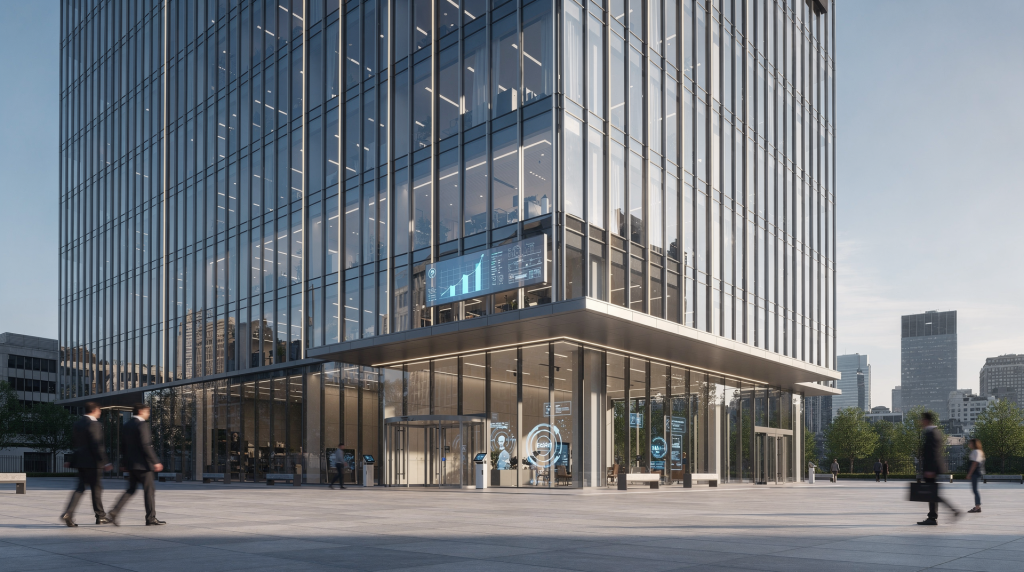
Smart building technology has moved from experimental to essential in commercial real estate. It’s no longer about gadgetry — it’s about creating an operating layer that connects HVAC, lighting, occupancy, security, and energy systems so the building responds to actual use, not preset schedules. For landlords, occupiers, and property teams, that means lower operating costs, a measurably better tenant experience, and far more control over how a building performs day to day.
The real value isn’t automation for its own sake. It’s the quality of decisions that become possible when you know how much space is genuinely used, where energy bleeds out unnoticed, which assets are degrading ahead of schedule, and how the physical environment supports — or frustrates — business operations. When you connect operational processes to the spaces where work happens, the building stops being a fixed cost and starts behaving like a managed asset.
What Smart Building Technology Actually Means
A smart building uses connected devices, sensors, software, and analytics to monitor and optimize building performance continuously. In practice, that means pulling data from multiple siloed systems into a unified view, then using that data to automate responses or guide operational decisions. The goal is to shift from reacting to problems toward anticipating them — and, wherever possible, preventing them entirely.
Common smart building components include:
- Building management systems (BMS) that provide centralized control of HVAC, lighting, and other core equipment. This is the backbone that coordinates mechanical and electrical systems.
- IoT sensors measuring occupancy, temperature, air quality, motion, energy draw, and foot traffic. These sensors turn physical space into a data stream.
- Automation rules that adjust systems based on real-time conditions rather than static timers. For example, a conference room that cools down only when sensors detect people, not because a schedule says 9 a.m.
- Analytics platforms that identify patterns, flag anomalies, and surface opportunities — from a chiller running inefficiently to an entire floor that’s booked but rarely occupied.
A useful mental model: a traditional building follows instructions. A smart building interprets what’s happening and adjusts itself accordingly. That shift from fixed programming to dynamic response is what changes the economics of operating commercial space.
Why Smart Buildings Matter in Commercial Real Estate
Commercial real estate leaders are under constant pressure to do more with less — less budget, less energy, less tolerance for downtime. Smart building technology addresses that pressure along three practical lines: it reduces operating waste, improves the occupant experience, and gives owners and operators the data they need to make confident decisions about their footprint.
1. Lower operating costs
Smart controls match heating, cooling, and lighting to actual occupancy and demand rather than running on fixed schedules that treat every hour the same. The result is fewer wasted kilowatt-hours and far less over-conditioning of empty zones. When you track energy spend per square meter against utilization, the savings often appear in the first full quarter after deployment — and they compound.
2. Better space utilization
Occupancy data reveals which areas are overused, underused, or configured in ways that work against the flow of work. For companies rethinking hybrid office layouts, evaluating consolidation strategies, or negotiating a lease renewal, this data turns gut feelings into evidence. If a 2,000-square-meter floorplate shows 40% peak utilization, the conversation shifts from “we need more space” to “we need a different layout — or less square footage.” That directly impacts the real estate footprint and the operating cost per square meter.
3. Faster maintenance and fewer surprises
Continuous monitoring flags faults before they become expensive failures. A fan bearing that starts drawing more current, a valve that’s cycling too frequently — these are early signals. When facilities management shifts from reactive to proactive, you reduce emergency repair costs, extend equipment life, and prevent the kind of tenant disruption that erodes trust.
4. Healthier, more attractive workplaces
Smart systems support comfort, ventilation, and indoor air quality in ways that tenants and employees notice. In competitive office markets, the quality of the environment often weighs as heavily as rent in occupier decisions. A building that consistently delivers fresh air, stable temperatures, and responsive maintenance creates a retention advantage that shows up in lease renewals and lower vacancy periods.
Core Technologies Behind Smart Buildings
Not every building needs every technology. The right setup depends on property type, age of the asset, tenant mix, and the specific operational goals you’re trying to achieve. The table below outlines the core components and what they deliver in practical terms.
| Technology | What it does | Practical value |
|---|---|---|
| IoT sensors | Collect data on occupancy, temperature, motion, air quality, and equipment status | Reveals how the building is actually used — not how it was designed to be used |
| Building management system | Controls and coordinates core building systems | Improves consistency and reduces manual oversight across HVAC, lighting, and more |
| Energy management software | Tracks consumption and identifies waste | Lowers utility costs and supports ESG reporting with auditable data |
| Access control and security systems | Manages entry, zones, and security events | Improves safety and tenant convenience while feeding occupancy data into analytics |
| Predictive maintenance tools | Detects abnormal performance before failure | Reduces downtime and emergency repair costs by catching issues early |
| Space analytics platforms | Measures utilization and flow patterns | Supports better planning, space allocation, and lease strategy decisions |
The integration between these technologies is what separates a collection of gadgets from a genuinely smart building. When occupancy data from sensors informs both HVAC zoning and space planning, you start to see compounding returns — lower energy bills and a footprint that actually fits how people work.
Where Smart Building Technology Delivers the Most Value
The strongest use cases aren’t the most futuristic. They’re the ones that solve persistent, expensive problems in commercial properties.
HVAC optimization
Heating and cooling typically represent the largest controllable energy loads in office and mixed-use buildings. Smart controls can adjust temperatures by zone, occupancy level, and time of day, avoiding the common pattern of conditioning entire floors for a handful of people. In multi-tenant buildings, this also allows landlords to align energy use more closely with actual lease obligations and operating expense recoveries.
Lighting automation
Lighting systems can be dimmed or turned off in underused areas, near daylight sources, or after hours. This is one of the easiest early wins: the hardware is relatively simple, the savings are immediate, and the data often reveals surprising usage patterns — like corridors lit 24/7 despite near-zero traffic after 7 p.m.
Occupancy-based space planning
If meeting rooms are constantly booked but rarely full, the issue isn’t capacity — it’s configuration. Occupancy data helps validate whether a floorplate, desk mix, or collaboration zone is actually supporting the work. That insight feeds directly into workplace strategy: do you need more focus rooms, fewer assigned desks, or a completely different ratio of open to enclosed space? The answer affects both the lease footprint and the layout budget.
Fault detection and maintenance
A system that spots a failing fan, valve, or sensor early can save both money and tenant disruption. In older assets, hidden inefficiencies accumulate over years — a damper stuck open, a pump running against a closed valve. Smart diagnostics surface these issues before they become tenant complaints or emergency calls, shifting facilities management from a cost center to a performance function.
Energy and carbon reporting
Smart buildings create granular visibility into energy consumption, which supports sustainability goals and performance reporting. For landlords, this is increasingly tied to asset value and leasing competitiveness, as institutional investors and corporate tenants demand verified environmental data. A building that can produce accurate, interval-level consumption data has a tangible edge in lease negotiations and portfolio reporting.
What a Good Smart Building Strategy Looks Like
A smart building strategy should start with business goals, not a technology shopping list. The most successful deployments I’ve seen begin with a clear operational problem and then work backward to the sensors, software, and integrations that solve it.
Step 1: Define the business outcome
Get specific. Are you trying to reduce operating costs across a portfolio? Improve occupancy visibility to support a lease renewal or consolidation decision? Support a workplace redesign that increases collaboration without adding square meters? Extend asset life in an aging building? Improve tenant experience to reduce churn? Without a clear objective, smart building technology becomes a pile of disconnected tools that nobody fully owns.
Step 2: Audit the current state
Review what systems already exist, whether they can talk to each other, where manual work still happens, what data is missing, and which spaces or assets cause the most recurring issues. This is where many projects stall: teams assume the building is “smart enough” because there’s a BMS in the basement, but in reality the data is fragmented, sensor coverage is spotty, and no one has a complete picture of how the building actually performs.
Step 3: Prioritize quick wins
The best first projects have clear ROI and low operational disruption. Common examples include:
- HVAC scheduling optimization based on actual occupancy patterns
- Lighting controls in common areas and parking structures
- Occupancy sensing in meeting rooms and shared spaces to validate demand
- Fault detection for high-cost equipment like chillers and air handlers
- Energy dashboards that give facilities teams real-time visibility
Step 4: Choose open, scalable systems
Avoid locking yourself into tools that cannot integrate with your existing environment. Integration matters more than flashy features. A good platform should work with the building’s current systems — even legacy ones — and grow with future needs across multiple properties. Proprietary black boxes might look impressive in a demo, but they create long-term rigidity that undermines the whole strategy.
Step 5: Measure results
A smart building program should be tracked like any other investment. Monitor energy use, maintenance response time, equipment downtime, occupancy patterns, tenant comfort complaints, and utilization of key spaces. If performance doesn’t improve after deployment, the technology isn’t the solution — or it hasn’t been implemented correctly. The data will tell you which.
Common Mistakes to Avoid
- Buying technology before defining the problem. Many CRE teams start with products instead of use cases. That leads to overspending and poor adoption because no one can articulate what success looks like.
- Ignoring legacy systems. Older buildings often have useful equipment that can still be integrated with modern overlays. Replacing everything at once is usually unnecessary and expensive — and it disrupts tenants.
- Treating smart buildings as an IT-only project. This is a cross-functional effort. Facilities, real estate, operations, IT, finance, and workplace teams all need input. When IT drives it alone, you get a network project. When facilities drives it alone, you get a controls upgrade. The real value sits at the intersection.
- Overlooking cybersecurity. More connected systems create more risk. Building networks, access controls, and operational technology should be protected carefully, especially when multiple vendors are involved. A compromised BMS can become a pathway into corporate networks.
- Focusing only on energy. Energy savings are important, but they’re only one part of the return. Utilization insights, maintenance efficiency, comfort, and tenant retention can be just as valuable — sometimes more so when they influence lease renewals and space decisions.
Smart Building Technology and Lease Strategy
Smart building data changes how companies evaluate leases and space decisions. If utilization data shows that a 3,000-square-meter office consistently operates at 50% occupancy, the real problem may be excess square footage — not a need for more collaboration zones. If occupancy peaks are concentrated on Tuesdays and Wednesdays, a different layout or desk-sharing policy might produce the same business output with less space. If comfort complaints cluster in certain zones, the building itself may be affecting retention and productivity, which has a direct line to the cost of turnover and the attractiveness of a long-term lease.
For landlords, smart features become part of the value proposition: a building that can demonstrate lower operating costs, better air quality, and responsive maintenance commands a different position in the market. For occupiers, the same data can justify consolidation, redesign, or a renegotiation of lease terms — shifting from a fixed footprint to a more flexible structure that matches actual usage patterns. In both cases, the technology supports an evidence-based real estate strategy rather than decisions driven by anecdote and expiration dates.
Practical Checklist for Evaluating a Smart Building
Use this checklist before committing to an investment. If several answers are unclear, the project isn’t ready yet — and that’s a useful signal in itself.
- Do we know the main problem we are solving?
- Do we have baseline data for energy, occupancy, or maintenance?
- Can current systems integrate with each other?
- Are sensors placed where they will actually inform decisions?
- Who owns the data and who will act on it?
- Can the system scale across multiple properties?
- Are cybersecurity requirements defined?
- How will we measure ROI after deployment?
When Smart Building Technology Is Worth It
It usually makes the most sense when operating costs are high, space usage is inconsistent or poorly understood, the portfolio includes multiple buildings with different performance levels, tenant expectations are rising, sustainability reporting matters, maintenance is too reactive, or the company is redesigning its workplace footprint. In these scenarios, the technology directly addresses a business pain point.
It’s less effective when the organization lacks ownership, discipline, or follow-through. Technology can only improve a process that someone is willing to manage. If the facilities team isn’t empowered to act on the data, or if the real estate strategy isn’t aligned with operational goals, even the best sensor network will gather dust.
FAQ
- What is the difference between a smart building and a building management system?
- A building management system controls core equipment — HVAC, lighting, perhaps some metering. A smart building adds connected sensors, analytics, and automation across multiple systems, turning the BMS from a control panel into part of a broader intelligence layer that informs decisions about space, energy, and maintenance.
- Does smart building technology only make sense for large properties?
- No. Smaller properties can still benefit from targeted upgrades such as occupancy sensors, lighting controls, and energy monitoring, especially when operating costs are tight and every square meter of vacant or underused space hurts the bottom line. The key is matching the scope of the investment to the scale of the problem.
- What is the best first smart building investment?
- For many commercial properties, the fastest starting points are HVAC scheduling, lighting automation, and occupancy analytics because they are relatively easy to implement, the savings are measurable, and the data they generate often reveals the next set of priorities.
- How does smart building technology improve tenant experience?
- It can improve comfort, air quality, access, responsiveness, and overall workplace consistency. In office environments, where experience directly affects retention and satisfaction, a building that adapts to how people actually use it feels more supportive — and that shows up in lease renewal conversations.
- What should landlords watch out for?
- The biggest risks are poor integration, weak data governance, cybersecurity gaps, and buying systems that don’t match the building’s actual needs. A flashy dashboard doesn’t compensate for sensors in the wrong places or data that nobody acts on.
Conclusion
Smart building technology earns its place when it turns building operations into a data-driven process. For commercial real estate, that means better control over energy, maintenance, utilization, and tenant experience — not just more automation for its own sake. The strongest results come from starting with a clear operational goal, choosing systems that can integrate with what’s already in place, and measuring whether the building is actually performing better after the upgrade. When you connect how a business operates to where it operates, the building stops being a container for cost and becomes a lever for performance.